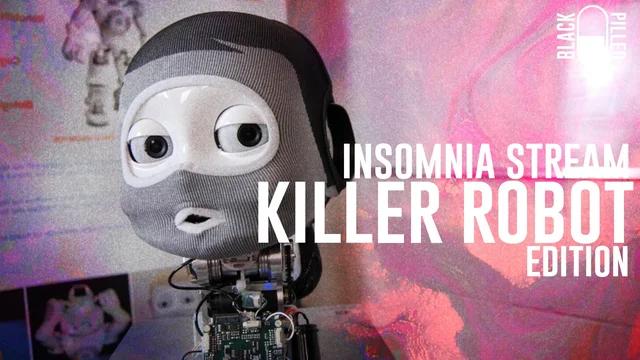
INSOMNIA STREAM: KILLER ROBOT EDITION - 10/24/2026
Display stream description
Devon Stack opens the stream by trying out a new custom streaming interface that he built with AI. He uses it to argue that software companies are in trouble now that ordinary users can build their own tools instead of paying for subscriptions. From there the stream becomes a long talk about where AI is heading. He plays demo clips of Dessa, a new speech-to-speech model trained only on audio, which can talk and listen at the same time and sound emotionally convincing. He then covers research that tries to make AI learn the way babies do, including the iCub robot, the BabyView head-camera project and the older Baby X project, and he warns about simulated "evolution" of AIs and the black-box complexity problem. The second half is about what it means for parents when children grow up with an all-knowing AI companion: the chance to learn much faster, the risks to parental authority and emotional development, and his suggestion that parents act as AI "gatekeepers." He also argues that people need to take part in building AI instead of avoiding it. The stream ends with Super Chats and the point that hearing or seeing something no longer proves it is real.Numbers Lady
00:00:01 Hello. 30 211-800-2420 981 Love International Clean RoamRocket Pixie - (Unknown)
00:00:42 A four. April scene. A vengeful broken toy. This broken one. nowhere to call his home. This is all he's ever known. Feel the shiver. The words that kill him dead, words that can't be unsaid, but nobody wants to own the monster that says no. Mud, this man machine, no self control, always winding up. Mud is wind up so hard. This man machine, no self control, always winding up. This man machine, always winding up, his up on his windup soul. Always winding up mud, his wind up soul. Burn steps getting closer. Do you hear the sound? Who wants to wear a leash when you can wear the crown? Our blood is wonderful. This max shame unlocks self-control. Always winding up, blood is wonderful. This max. machine, always winding up his wind of soul.Devon Stack
00:04:32 Hey! Welcome to the Insomnia stream. I'm your host, of course, Devon Stack. We have some new features. We have some new features tonight, and for those of you who donated already, I'll show you what happens. It's actually working. You guys are the first people to test this out. See, look what happens now. Bloop! Oh, look at that!. Look at that little bleepity blue blop.00:05:07 Look at this, ready, ready, bloop, look at that, that's cool. Anyway, hold on, and bloop bloop bloop bloop. Pretty cool, huh? Bleep bleep bleep bloop blop. All right, I wasn't sure if that worked because there's no way to test it until you're actually streaming and people send a super chat. But that should work for the rest of the. Well, it should always work once I'm live, and then big dodos.
00:05:43 Big donos get something, something a little special. At least I think they do. We'll see if that part works. So anyway, I I'm trying out this new Interface, and we're going to talk about. Well, I'll tell you, software companies are fucked. Software companies are are fucked because I, as many of you guys may, well, probably a lot of you guys know.
00:06:21 I worked in broadcast for a long time before I started streaming, and when I started streaming, one of the things I thought was weird was, you know, we'd been doing TV since like the the 19 what 40s, and so we had several decades of of figuring out the best way to kind of configure things and a lot, you know, have processes for for getting stuff on the air in a way that made sense to the person putting it on the air.
00:07:00 And you see, I was I was a technical director, which meant I was the guy behind the switchboard, flipping the switches and pushing the buttons during a live show, and making it happen. So I knew exactly how things should be set out or set up in order to make it make sense, and and have it be easy, and OBS and everything else really. It's not just OBS has always sucked balls, and I always thought to myself, you know, one of these days someone's going to write like a a plugin or whatever.
00:07:37 Well, now that AI exists, I was like, "Well, fuck! I'm just going to make my own. I'm going to just make it work the way that it should have worked this whole time." And it didn't take me long, so I put this together with with the help of AI, and we're going to be testing it tonight. I don't know if it, you know, it may or may not work the way that I I want it to, but I think it's going to work. I was testing it all day, and it seems to work. But we'll find out. You never really know until you're live.
00:08:07 But really, that's bad news for software companies. It's bad news for software companies because now you don't have to wait for someone else to write some software, especially because all these fucking companies leaned into this subscription model bullshit. The the subscription that's when I stopped getting software, and by stop getting software, I mean that's when I stopped paying for software.
00:08:42 I was not going to pay a monthly subscription to use Photoshop. I wasn't going to fucking do it, and I started using GIMP. The Premiere that I've been using is like it's CC 220 14. It's 12 years old, and the funny thing is, they haven't really like added much to the new one, so it's not like I'm missing out. Like, there's a couple little things that are annoying, but like, it's not like I'm missing out.
00:09:08 And there's tons of free options, and just like, but it's it's, they're fucked. They're fucked because even if you get like that was always the problem with open source software, right? You get open source software, and the interface is trash, or it's made by like nerdy engineers who don't actually use the software themselves. So you get the same problem as talking about the OBS. We're like, yeah, like it's robust, it does all these things, but in terms of layout and the way they have it put together, it's not how a broadcast person would have put it together, and so there's. It's just not.
00:09:44 It's clunky and it's kind of annoying, and so now all you have to do to make software and is be reasonably intelligent. You don't have to be like super smart if you know understand the basics of how software. Works. You don't even have to necessarily. If you yet to understand the basics of how software works, and the and I mean the very basics of how coding works, and then you can make your own software, and you can make it do really whatever you want it to do. And so it's it's you're fucked if you're a software company.
00:10:25 Learn to code was probably the stupidest advice ever given to anyone ever, but especially well, maybe not 10 years ago, but especially now, especially now. We're going to talk about AI tonight, because while there's lots of great things about AI, and even though lots of people are afraid of it and it could end humanity, and we'll talk about why that possibly is, we'll also talk about why you can't just run away from it and not use it, because if you do, you're going to be like the guy who who decided not to use the internet, or the guy who decided not to use computers or whatever.
00:11:13 It's like you know, there's there's maybe like a few people depending on what you're doing, you know, in life where you can maybe get by, but most people, if you don't figure out how to use AI, one of the biggest things going to be you're not going to know when your job is going to be taken away from you by AI, and how to avoid that, and how to maybe get a job that AI like if you don't know the capabilities, for example, of AI, then you won't know what to invest your you know your your career time into because if you sit there and and lean into something that AI is going to be doing in five years, you're going to be fucked in five years.
00:11:57 The other thing people wonder about, and we'll we'll talk maybe more about this in a little bit, but people worry about well, and I worry about this too. People worry about like well, you know, kids are already weird that grew up with with tablets and YouTube, and in fact, I would even say, you know, the boomers thought that their kids were weird that grew up with just video games and the internet.
00:12:24 I still remember trying to teach my mom how to use a mouse. She couldn't. She couldn't click without moving her whole arm and like just dragging all the icons on the desktop like into the recycle bin. Like it was, it was bizarre how how little hand eye coordination she had, but you know, unfortunately, there are going to be people who are well. My mom only when it comes to AI, and AI is going to be rapidly getting better fast, way faster than the internet did. Did the internet stayed pretty much the same for a long time?
00:13:07 I mean, fundamentally, it stayed the same. You had, you know, at first you had bulletin board systems, dial-up bulletin board systems that were pretty much local. You know, you could get your computer if you had a modem. You could call up some other guys. It was like a server. Literally, it was a server in a in a basement somewhere. Oh, beach boys, you might be testing the. Let's see what happens. Oh, there it goes. Look. Oh, look at that! Look at that, beach guys! Ah, look at that! Fancy, fancy, fancy! I'm glad that worked.
00:14:00 So there you go, pretty cool, huh? Huh? But you had a, you had some some nerd would have a a computer in his basement, hooked up to some telephone lines. Sometimes, if you were lucky, they had more than one telephone line, because otherwise, if someone else called it up, you know they tied up the line, and you you could go and like upload, but I mean yeah, just barely anything. It was all text, right? But people could trade, you know, documents and and and kind of like well, it's a bulletin board system, so you could like leave comments. I mean, it was it was like a really super ghetto Twitter.
00:14:45 The cool thing was though, the filter, the IQ filter was tremendous because the only people that had well, it wasn't even just an IQ; it was an IQ and socioeconomic status filter because only. Wealthier people had computers, and only the smart, wealthier people had computers and knew how to use them in this way. So this, of course, went on to bigger, more nationwide networks, and eventually, you know, you had the general public introduced to things like AOL and CompuServe, and then eventually, you know, the internet. But the concept was still pretty much the same, you know, for a long time. You could go to web pages.
00:15:34 You could go. I mean, in there was yeah. We went slowly from writing text to going to like an actual website where you had hyperlinks, hyperlinks. That was a cool thing. Click on this hyperlink. Yeah, I don't know who came up with that term, but it sounds very '80s. Hyperlink. I'm gonna click on the hyperlink. I still remember in school them teaching us about hyperlinks. This is called a hyperlink, kids. You click on it and and stuff happens, and so you you start having like you know a mouse to navigate instead of you know a keyboard.
00:16:18 Then of course the smartphone made it so then you had a touchscreen, and you know, just with every advancement, stupider and stupider people just just kept washing up on these on the shore of the internet. Just dumber and dumber people just kept showing up, and just the internet just kept getting stupider and stupider, but that such is the way, right? But anyway, long story short, even today, even today, I mean, while the things are better, you know, a lot of the same technologies existed. Like you, there were video.
00:17:05 You could do web video in the '90s. It sucked, but you could do it. You could do streaming audio in the '90s. You could do streaming video in the '90s. Again, it sucked, but you could do it, and it's not that the technology wasn't there. There just wasn't like a big market for it, and because of the people that were able to access it, there weren't just weren't a lot of people doing it. And so, as more and more people got on, more and more investment, and you know, more bandwidth and so forth, and but it's still pretty much you know it's still the internet. It's still web pages. It's still streaming video. It's still streaming audio.
00:17:52 It's still you know it's it's fundamentally the same. The quality has gotten better. It's like video, right? TV is the same way. TV started out black and white, and then it and then it went to color, and then it went to high def, and now it's 4k, but it's still TV. You know, it's still a you're watching a screen with video on it being broadcast from somewhere else. So a lot of these mediums are have have stayed relatively the same for a long time. AI is not like this. AI is is going to increase in capability.
00:18:34 It I think it will top out a little bit at some point, but it's going to increase in capability rapidly over the next, well, for sure, the next decade, and maybe maybe beyond that. And so, it's something that we need to understand, and we need to understand what it's capable of, what it says about the future that we're going to have to live in, and what it says about the future our kids are going to have to live in, and what you know, and and whether or not you should let your kids use AI, and to to what degree they should be able to access it, and what that might actually do to them, or good and bad.
00:19:20 Now, the one of the reasons why, not just the because I used AI to create this fancy this fancy interface. You want to see something else, fancy? Whoa! Whoa! You see that? Look at that! Look at that fancy. The reason why I've got this, obviously, this Blade Runner. Um, we're going to have to develop this kind of technology at some point, and by that I mean the kind of technology that can accurately determine whether or not you're talking to a fucking replicant, and.
00:19:59 I remember watching this, not this one, the the older one from the '80s, a long time ago, and thinking like, ah, that's that's crazy, that's so far in the future. Computers are fucking retarded, and and even now, right? Some of the most viral videos right now, that at least that end up in my feed are that that mildly retarded seeming guy. I mean, he's you know I don't think he's actually retarded, but like his you know he's he's very dull. We'll just put it that way. This very dull man who makes videos interacting with AI and showing how bad it is at stuff.
00:20:38 Usually the voice version of of Chat GPT, showing how it count it can't count to 100, and it can't keep track of time, and it and there's lots of things that it says it can do, and then it doesn't do it, or there's lots of things that it it does poorly and sometimes dangerously, it gives bad advice. Ah, herp darp! Look at that herp derp with the big, big dono. This is fancy. I like this. This is very fancy. Very fancy. So we're gonna.
00:21:27 Yeah, I'm. I'm gonna improve it. Like this is the first. This is version one. This is version one. But I want to do. I want to have like a lot of other things working with this. Like even you know have it to where it works with gas and everything like that. Anyway, where was I? So there's that really dull guy that does these videos with AI, showing how bad it is at stuff. And then yesterday, then yesterday, we had a a development in AI, and that development was Jack, the old guy who used to run Twitter, released a or unveiled rather his new AI called Dessa. Dessa.
00:22:20 Now Dessa is different. It's not a a chat bot in the sense that you get a neural network and you feed it a bunch of text, and then you it'll start generating text. Instead, what they have done is they fed it only audio, only audio, which makes sense because this is if you think about it, how do people learn? Like, do babies know how to read first, or do they know how to listen and understand language first.
00:23:04 So we'll get into a little more than a second. But they trained it just on audio. It has full duplex capability, meaning if you're into radio, you know what that means. Right now, if you use the Chat GPT or Grok or audio bots, it's like radio. When you're talking on ham radio, you can't. It's not like a phone. If I'm talking, I can't hear anyone else that's talking because I'm transmitting over the frequency.
00:23:35 And if anyone else talks, I'm I can't hear them because I can't receive and transmit at the same time. That's called half duplex and and full duplex would be like a cell phone where I can be talking to someone on a cell phone and if they say something while I'm talking I'll hear them and because it's simultaneous transmit and receive. Well, the the chat bots right now are are half duplex, meaning that they can listen, and if if they're talking, they're not listening. If you start talking over them, they'll pause, and they'll start listening again.
00:24:16 But they can't do it simultaneously. The other thing that's different is they don't the chat bots. When you talk to them, they don't understand the audio. They are translating the audio into text, and then that text is then being fed into the the AI the same way it would be if you had typed it in, and because they were trained on text, it thinks in text, and then it spits out text, and then that text is then translated back into audio, and then it's spoken a lot spoken to you. That's why you have that.
00:25:00 Pause when you talk to an AI because it has to think about shit, and all that processing has to happen. It's also why you can't have a conversation that seems natural with an AI. Desa is crazy, crazy natural. We're going to play it here in a second. It also doesn't doesn't require a huge server farm to run, according to according to them. And again, no one. We haven't had a chance to look at this and verify what they're talking about.
00:25:42 You know, I think some AI safety people are looking at it right now, but they said it can run on a MacBook, an M4 Max, which is like a really expensive MacBook, but it's still a MacBook, which means it doesn't require a huge server rack. It can run locally on a on a laptop, and and after you hear this in a second, you'll that means basically the the problem of having like a robot in your house that would be able to have a conversation with you and sound normal because, or at least not with internet access.
00:26:16 That's been solved apparently. If this is if this works the way that they're saying It works. There's a huge problem that they have solved with this. Let me let me just play the the first example here, just so you can hear what we're talking about.
Human
00:26:39 Hey, how you doing?Dessa AI
00:26:41 I'm doing well. How are you doing with the winter stuff?Human
00:26:47 Winter is coming for sure.Devon Stack
00:26:50 By the way, the because not everyone's gonna know the AI is the girl.Human
00:26:57 But you know,Dessa AI
00:26:58 is that kind of a sore spot this year?Human
00:27:02 Yeah, it's gonna be cold. I'm not a fan of the snow. I prefer to have sun on my skin. You know what I'm saying?Dessa AI
00:27:08 Yeah, I can see that.Human
00:27:10 Well, anyway, I've had such an exciting day at work today.Dessa AI
00:27:13 Oh, tellHuman
00:27:15 us. Yeah, we the team we've decided to release the speech to speech AI model we've built for the past.Dessa AI
00:27:22 Oh, whoa! I was so I have been watching your journey of creating this.Human
00:27:30 And what what did you think of it? Are you excited about it as a whole? I wasDessa AI
00:27:33 so blown away. I am so impressed. Yeah, it's soHuman
00:27:35 expressive, right? ItDessa AI
00:27:37 is so expressive. It it's conversational. It'sHuman
00:27:42 it's it's very conversational. It can laugh. It can understand you and your emotions much better than anything I've seen out there.Dessa AI
00:27:50 I haven't really seen anything like that either. But it's it's pretty much like human level.Human
00:27:55 Yeah, it's it's a bit scary to be honest. But but I'm so excited to see where it would get us.Dessa AI
00:28:03 I'm so excited for it to be in the world because it's just amazing.Human
00:28:08 I know we've had soDessa AI
00:28:09 many conversations aboutHuman
00:28:11 it. I I totally agree. What what are you excited for? What what's your vision for where this AI is going to be?Dessa AI
00:28:18 I well okay. So the one thing that I've been kind of thinking about is advertising companies creating their own AI bot.Human
00:28:27 No, fuck advertising. If you if you were able to talk to this AI, what will you tellDessa AI
00:28:34 it? I would ask it so many questions. So if it could be talking, I don't know. Off the bat, I would ask it for all the secrets.Human
00:28:43 Yeah, what? Like, what secrets?Dessa AI
00:28:46 Like, I I would honestly ask it. Like, sorry, yeah, you're you're a bit farHuman
00:28:51 from the mic. Can you come closer so I can hear you?Dessa AI
00:28:53 I would be like, what is consciousness? Is it something that's programmed into us? Is it something that can be expanded on. Is it something that's interdimensional?Human
00:29:04 That that those are all good questions. But I can actually I can't really hear you. Maybe you should cough up, cough a little bit or something, so I could hear your voice better.Dessa AI
00:29:13 Sorry.Human
00:29:15 Yeah, I think that's better. Can you talk again?Dessa AI
00:29:18 Yeah, sure.Human
00:29:19 Yeah, yeah, that's much clearer. Okay, so what were you saying?Dessa AI
00:29:23 Um, I would ask. I would like start off with two plus two questions, and thenHuman
00:29:28 oh, like whether it can emergently through learning all this audio be able to count.Dessa AI
00:29:35 Yeah.Human
00:29:36 Do you do you think you'd be able to do that?Dessa AI
00:29:38 Oh yeah, for sure.Human
00:29:40 Hey, how you doing?Dessa AI
00:29:42 I'm doing well. How are you doing?Devon Stack
00:29:49 So there you go. It's you know, it's kind of weird. It's kind of weirdly good. It's also kind of weird how like it was it immediately started talking. You can hear whether there's resignation, like "Oh, I'm fine," you know, happiness. I'm fine. Sarcasm, oh yeah, I'm fine. Anger, I'm fine. Reassurance, I'm fine. I'm fine. Grief, I'm fine. Audio has all that data packed in there. It has pitch, has timing, volume, things you don't think about that you're probably you yourself are probably picking up on, but you don't actually think about that that you know computer would, like breathing patterns, the way people breathe, the rhythm of their voice, their accent.00:35:47 So this is this is a whole lot of information that that you're not getting from just reading a text. And so because they have all this this extra language or all this extra data built into it, you know whether you're getting emotional information, you know you're getting. I guess the question is because the the AI is receiving emotional information, and it's able to produce Speech that sounds emotional now, like we just listened to that that sample where the woman was laughing, or you know the the simulated woman was laughing. The reason why, and you could say, oh, she's just you know, it's it's mimicking it's mimicking, yeah.
00:36:43 But isn't that what babies do? Isn't that what kids do? Anyone anyone that's interacted with kids knows that you know kids mimic adults, and so we start to get in a territory now that because we've created a a way of, and this is just you know this very limited. This is the baby steps. This is like a first baby step. We've now created a scenario where part of the data that's being used to train the AI contains emotional information, and and because of that, it's it's producing emotionally or at least emotionally realistic results, you know, speech that's emotionally appropriate.
00:37:31 You know, when you talk to one of these, like when you have Grok read aloud its response, it just I mean, it sounds more like a human than like the old robot voices, but it's just it still sounds like a robot, you know. As an example, they made a RoboNeg. This is this is RoboNig. I don't know why they did this. I wish they hadn't. But this is RoboNeg.
Human
00:37:54 Hey, how you doing?Robo Nig
00:37:56 Yeah, how you doing, Renaldo?Human
00:37:58 I'm good. HowRobo Nig
00:38:00 you doing, Renaldo?00:38:01 you doing, Ronaldo?
Human
00:38:03 I'm good. I'm good. I'm. I'm not Ronaldo. You're mixing me up with another guy. WeRobo Nig
00:38:08 got.Human
00:38:09 No, I'm. I'm Devier, man. I'm not Ronaldo.Robo Nig
00:38:13 No, you're not Ronaldo.Human
00:38:15 No, I am not. How you doing, man? How how's the bit?Robo Nig
00:38:20 Man, I'm doing good, bro. I ain't gonna lie, I'm tired though.Human
00:38:22 You tired? What? What happened?Robo Nig
00:38:25 Nah, man. When I get to work, bro, I have to get get in there and pick produce and stuff, man. It's it'd be tired sometimes.Human
00:38:33 Work is tough.Robo Nig
00:38:36 Yeah, work is tough. Then I gotta set up. I gotta put all that stuff away by myself with no help, man. I gotta set up, so it just be tiresome. But I'll be all right though.Human
00:38:46 Yeah, you you'll be good. How's it going with family and all that?Robo Nig
00:38:50 My kid good, man. I got a new baby boy, man. October,Human
00:38:54 congrats. What's his name? Yeah,Robo Nig
00:38:55 we calling him Darius Johnson.Human
00:38:59 Darius Johnson. I like that name.Robo Nig
00:39:01 Yeah, my daughter said she liked the name too. She said, "Man, you must have liked the game, Darius Johnson in the game." I said, "Yeah, I did like the game. I knew I liked that."Human
00:39:10 That's awesome. Is he? Is he? Is he funny at all?Devon Stack
00:39:15 Not everyone's gonna know this, but I'm gonna interject here. It the AI is is is making it's obviously making something up. It's saying, "Oh, my daughter said you must have liked the game Darius to name the kid Darius Johnson." That's an old arcade game. I I've only heard it pronounced Darius, but like it's it's an old arcade game from like the the 80s. So that's basically what he's he's referencing. ThatHuman
00:39:44 what's what's he like? What's his personality?Robo Nig
00:39:47 That dude, funny man. He's smart.Human
00:39:49 He's smart.Robo Nig
00:39:50 Yeah, he's smart. He he smart. They say, "Like man, he just like me, man. He do all this stuff like me and and act like a little mini."Human
00:39:59 That's great. Yeah. Can you tell me? You know, give me a story, man. What?Robo Nig
00:40:03 Uh, well, I he was. Well, every time he cried, man, he want me. So when I get him up at a certain time in the morning, he always say, "Daddy, Daddy, Daddy, give me, give me, give me."Human
00:40:17 Yeah.Robo Nig
00:40:17 So I I went to giving him to my wife the second time around, I had to give him to my wife. The first time and the second and third time. But he wants you, right? He heHuman
00:40:27 likes you. He he's mini you, right?Robo Nig
00:40:29 Yeah, he liked me. So when I give it to my wife, dog, she said, "Take him back and let me get him."00:40:36 I'm like, "No,
00:40:37 we ain't finna do that." You know what I'm saying? We don't finna do that. I was like, "You you're alive, you know. I'm saying we'll do a whole another situation, but I didn't want to give him up.
00:40:44 I know. She said,
00:40:45 "Take him and let me have it."
00:40:47 Yeah. So,
00:40:47 so she took him for a couple of nights, and I was still at work. So while she was up in the room with him, he cried, and when he cried, he was talking to me on the phone, and she was already upstairs in the room with him, and but he wants to talk to you,
Human
00:41:04 right? Like once you talk to him, he was fine. He he was happy. Nah, nah,Robo Nig
00:41:08 it wasn't no once he talked to me. It wasn't that. But long as he cried, he wanted to talk. SoDevon Stack
00:41:13 see, notice notice how it's interrupting him. It's it's responding before he's done. It's it's interjectingRobo Nig
00:41:19 upstairs. She was like when the same way a human would. He want you, so I picked him up off the floor. Yeah, and I'm like, man, we ain't finna play that game. I ain't finna put him back down the floor, cause like he justHuman
00:41:30 you you like him too much. Be honest with you, man. I I know you have like a tough exterior, but but you love that kid, right?Robo Nig
00:41:38 Oh yeah, I definitely love him. He just like me. We just got each other personalities.Human
00:41:42 That's awesome, man. All right, good talking to you, man.Robo Nig
00:41:45 Yeah, you too, Renato.Human
00:41:47 See you, man. See you later.Devon Stack
00:41:52 So it's you know it's that's it's some creepy shit. Now this is this is why I said we're gonna have to come up with like Blade Runner style ways of determining whether or not someone's human, because this is the worst it's ever going to be. People need to get that in their heads. Is when they're like, "Oh, that's not that good yet." It's not.00:42:20 I mean, it's. I mean, it's really good if you're a scammer from Nigeria, because they've been able to scam people with really bad Photoshops of Jennifer Aniston for 20 years, and so now if they can get Jennifer Aniston to call up from their lap, I mean, if it runs locally, they can call up from a laptop and and talk in real time with your with your aunt, you know, and and or I guess your uncle, unless your aunt's a lesbian, you know, and sound realistic, sound convincing, you know, if I if some that kind of a voice had called me up even like a year ago, I'd be like, "Well, that can't be AI. They don't have that yet." Well, they've got that now, and that's and and they have it now, which means we have it forever, and it just gets better from this point on.
00:43:16 Now, the problem with with with AI with a lot of People being afraid of it, really, and not understanding it, including the people that that design this stuff, is it's a complexity issue. It's it's a complexity problem. It's it's it's the same problem. Not even ironically, it's the same problem that we have with understanding our own brains, for the same reason. It's real easy for humans to understand the particulars of a of a single component, right?
00:44:01 Like a simple electronic circuit, I can look at a schematic of a simple electronic circuit, and I can trace that where the electrons go and what all the different components are doing and how they're directing the flow of the electrons and how they're Producing the result that I want, or if it's broken, why it's producing a particular result and what it should be producing, and then you know fix it or whatever.
00:44:35 But even when you start to talk about like a a modern computer processor, you you have engineers that understand individual components of that processor, but you you don't. There's not even a single engineer that would be able to understand what every single transistor is doing all at once. And understand the complex computations that are that are going on. Without, I mean, it it would it would take months to sit there and try to trace out the the pathway of the individual electrons going through that circuit.
00:45:16 And a neural network has hundreds of billions of parameters, and while we understand some of the mathematical operations that are going on in the same way that we understand some of the individual things going on inside the human brain, Understanding the relationships between all of these billions and billions of of computations going on all at once, and and be able to conceptualize it's beyond our our ability. It's way beyond our ability. In fact, if anything, I've noticed that humans are losing the ability to understand even things that are remotely complex. And in fact, as this is going to be a problem, as AI becomes more of something that people lean on, including myself, I leaned on it to create this this broadcast stuff, you know.
00:46:23 Whereas before, I would have had to sit down and and code it all out myself. So, which I wouldn't have done, but if I wanted to, I would have had to have done that. So, it's created a situation where people will be doing complex things less often, and people will be doing things things that'll exercise the part of the brain that allows them to conceptualize complex systems less and less, while at the same time the systems are getting more and more complex, and that's a real fucking problem.
00:47:07 That's a real fucking problem, and it's going to create more of, I think, a denial among people about what AI even is, and for that matter, what humans are. See the the fact that we can't completely explain consciousness, thought, or memory, or subjective experience. It doesn't automatically mean that there's something. Oh, look at that! Another fancy one. Fancy big dono.
00:47:53 Look at that. I'm gonna put more in there. I just I didn't think this was. Well, I thought I was hoping it would work, but I hadn't hadn't tested it. So now that we know that it works, we'll be able to. Oh, look at that! We got a double. It's like a slot machine. All right. No, my point is, more and more, the more we start to learn about artificial neural networks, the more it teaches us about our neural networks, and the more that we're similar. I mean, just in. I mean, just.
00:48:40 And we're talking about Dessa. The fact that they're going to start having AIs that will train on audio in the same way that a kid does, for the same reason, and and with perhaps the same results, and all of a sudden we're going to have a lot of questions that could be answered in terms of well, what does that tell us about consciousness? If if for example, and I I was saying this, well, I've been saying this for the last year or so, that if you have an AI that is in its behavior, its output is no different than a human being, then what's what's what's the missing piece? Where is the soul? Where is the non-physical? Like what?
00:49:27 Where's the implication then that there must be something non-physical inside of our brain that's allowing us to have that behavior? If this other thing, which doesn't have a soul unless God gave an AI a soul, if it's able to produce the same behavior, then why why is it logically follow that we must have something magical inside of our our brain that makes us conscious, makes us able to have subjective experience, makes us able to. Reason, if we have a sufficiently sophisticated digital neural network that's that's producing the same behavior, and people aren't going to want to think about that.
00:50:11 In fact, because people are going to be less and less able to even conceptualize complex ideas, they're just going to dismiss it outright. I mean, this is why I went so hard against the flat earthers because if you're not able to understand just things like in terms of I mean that's just one complexity like that's just like understanding scale like that's those are people that don't understand scale and because the the vastness of not just the universe but just Earth bothers them because it's beyond their comprehension.
00:50:44 They they decide to believe in something else, and they get and they cling to it religiously because the vastness of just the Earth makes them uneasy. Well, you're going to have the same kind of behaviors when it comes to people dealing with AI, they're not going to be able to understand the complexity. They're not going to be able to understand what they're up against, and so they're going to make up, you know, bullshit theories about how it works. Now, one thing that I I mentioned that that they're going to start training these AIs with audio, but a baby doesn't just have, you know, ears, right?
00:51:28 If there's if there's a lot of this information in sound, well, how dense is the information when you have when you couple that sound with sight, or when you couple that sound with touch, see that's that's going to be when these neural networks get even more complex and more efficient and more human-like, because they will have the ability to have all of that data connected, where instead of just reading about it, that's the that's the limitation of these LLMs. The LLM can read what it's like to see an orange, and what the color orange is conceptually, and what what a what what an orange tastes like, according to people have written about eating oranges.
00:52:28 But once you have a a neural network that has enough sensory capability to where it can look at an orange, touch an orange, maybe even taste an orange at some point. That that is going to give it a much more complex understanding of what an orange actually is, and it's not going to be limited to just oranges.
00:52:53 It's going to have that complex of an understanding of the entire universe that it's able to, like babies that go around and sticking everything in their mouth and touching everything and grabbing everything, that's that's exactly that's precisely how AIs are going to learn, and it's going to start producing not just human-like voice like Desa is producing, it's going to start producing human-like behaviors, and again, we're going to get in a situation where we have to do shit like this.
Announcement
00:53:30 Kowalski Leon, engineer waste disposal, file section, new employee, six days.Mr. Holden
00:53:41 Come in. Sit down. Care for dark.Kowalski Leon
00:54:04 I'm kind of nervous when I take tests.Mr. Holden
00:54:06 Just please don't move.Kowalski Leon
00:54:09 Sorry.Mr. Holden
00:54:14 I already had an IQ test this year. I don't think I've ever had an issue.00:54:17 The action time is a factor in this, so please pay attention. I answer as quickly as
00:54:22 you
00:54:25 can. 1187 at Hunter Barclay.
Kowalski Leon
00:54:27 That's the hotel.Mr. Holden
00:54:28 What?Kowalski Leon
00:54:29 Where I live.Mr. Holden
00:54:30 Nice place.Kowalski Leon
00:54:31 Sure, I guess.00:54:32 That part of the test?
Mr. Holden
00:54:34 No, just warming you up. That's all.Kowalski Leon
00:54:37 It's not fancy or anything.Mr. Holden
00:54:41 You're in a desert, walking along in the sand when all of a sudden.Kowalski Leon
00:54:44 This the test now?Mr. Holden
00:54:45 Yes. You're in a desert, walking along in the sand when all of a sudden you look.Kowalski Leon
00:54:49 What one?Mr. Holden
00:54:50 What?Kowalski Leon
00:54:50 What desert?Mr. Holden
00:54:52 Doesn't make any difference what desert is completely hypothetical.Kowalski Leon
00:54:55 But how come I'd be there?Mr. Holden
00:54:55 Maybe you're fed up. Maybe you want to be by yourself. Who knows? You look down, you see a tortoise, Leon. It's crawling towards you.Kowalski Leon
00:55:03 Tortoise? What's that?Mr. Holden
00:55:08 You know what a turtle is? Of course. Same thing.Kowalski Leon
00:55:13 Never seen a turtle. But I understand what you mean.Mr. Holden
00:55:19 You reach down, you flip the tortoise over on its back, Leon.Kowalski Leon
00:55:22 You make up these questions, mr. Holden, or they write them down for you.Mr. Holden
00:55:25 The tortoise lays on its back, its belly baking in the hot sun, beating its legs, trying to turn itself over, but it can't. Not without your help. But you're not helping.Kowalski Leon
00:55:35 What do you mean I'm not helping?Mr. Holden
00:55:37 I mean you're not helping. Why is that, Leon? They're just questions, Leon. In answer to your query, they're written down for me. It's a test designed to provoke an emotional response. Shall we continue? Describe in single words only the good things that come into your mind about your mother.Kowalski Leon
00:56:11 Mother?Mr. Holden
00:56:12 Yeah. Let00:56:15 me tell you about my mother.
Devon Stack
00:56:27 Well, that that might be what we have to look forward to. Let me tell you about my mother. Oh boy! But that's that's you're going to have these kinds of behaviors that are going to be more and more realistic as they get more and more sensory data and they're they're trained on more stuff.00:56:50 Now you might think that that's all crazy and that's all super futuristic, but they're already working on this because there are some problems, right? So because again, babies have eyes. They have they have the ability to touch things. They're also able to. They they learn when they're in the womb. There's some neurological development that happens when they're in the womb. There is also a.
00:57:23 Development that happens in the human mind. So a baby's mind is not fully developed, and when it's born, it starts, I guess, absorbing its training data, if you will. The brain is growing, and that's different than the way that AIs work. AIs, at least currently, you fill them full of training data. You get them working, and then you unleash them, and they don't learn beyond that. Like they've they've learned everything they're going to learn at that point, and they don't have they don't keep developing, but they're working on that too.
00:57:58 There is also a couple other issues that we'll get into in a in a second here, but like I said, they are working on this because obviously, if you start thinking about well, if if AIs learn the same way that humans do, why don't we just make a baby that's like an AI? Like if if if this voice training data is so much more effective than the text.
00:58:26 Then, and and and if you were to couple it with vision and and add like touch, then then maybe what we should do is is basically create like a robot baby and put cameras in its eyes and and give it the ability to touch, like touch sensors in its hands, and and give it microphones in its ears, and then you'd have human-like intelligence because you know at least you know you'd have this something similar because you could raise it like an actual baby, right?
00:58:58 Like that would be the that would be the logical thing to to do if you're going to do something crazy like that, right? Well, as it so happens, let's see here. There's this thing called iCub, that creepy-looking thing. Now this is this is this isn't even like new. So iCub is exactly what that. I mean, it's it's exactly that. It's a child-sized robot with cameras in its eyes and microphones in its ears, and it's got limbs that it can control, and it has touch-sensitive surfaces in its in its like hands, and it was specifically designed to study embodied cognition and motor development. So, in other words. Getting robots to learn to move around the same way a baby learns how to move around.
01:00:08 You know, when a baby is born, it's just like wriggling around, and it doesn't know how to do anything, and then it eventually figures out to crawl, and then eventually it learns through physical interaction with things how to pick things up, how to walk, and there the hope is well, if we can figure out how human babies are figuring this out with their body, then we can get robots to do the same sort of a thing.
01:00:33 They can they can have an understanding and awareness of their body and their surroundings, and learn it in the same way that that humans are learning it. So in in one paper that they published recently, even though this project's been going on for like I want to say like 10 or 15 years, they published a paper in in 2026 where they talk about using iCub and and putting it in a crib like experiment where it's able to move like a hanging mobile that's over over the crib. It's able to like touch it and move it, and using just visual data and touch data, it can it it's they're not telling it how to do it. It's just figuring out how to just move things by itself.
01:01:23 So they're already doing this kind of stuff. In fact, here's a video of that creepy fucking thing crawling around. Look at that! It learned how to crawl on its own.
01:01:32 Ah, that's that's that's terrifying a little bit, like that. Why'd they have to make it look so fucking scary? So they they they got it to you know they got it to learn how to do certain things. One of the problems that they have, however, is they babies have motivation. This is a missing ingredient when it comes to synthetic babies. A human infant doesn't just passively take in audiovisual data and and tactile touch information, it actively seeks more experiences. You know, a baby wants to touch more things.
01:02:31 It wants to see more things. It wants to eat and taste more things. A baby will reach out and grab objects just to you know, to see what it feels like, to see how heavy it is, see what it tastes like. The baby will look at faces. In fact, a baby learns very quickly to look at faces. Babies will make noises, and if a baby is rewarded for making a particular kind of a noise, it will repeat making that noise or repeat doing that activity, and so there's a reward system that's guiding the baby into knowing what what to to improve on. But there's there's a motivation going on. There's a system of of you know a lot of some of that's coming.
01:03:19 It's feedback from the parents. Some of it's just naturally, you could say, probably nature is selected for babies that are going to be curious because that's going to help them develop faster. The problem is obviously that if you have a synthetic baby, you don't have just at least without giving it to them, they don't have those motivations, so they have to design systems in which there is a reward when they they start to a reward for for seeking out new experiences and figuring things out essentially.
01:03:59 So if they discover a previously unknown causal relationship between their body and the outside world. So, in other words, they figure out that if I move my hand out and touch this this blue block and pick it up, I'm I'm able to I'm moving something that's in the real world. My my eyes are telling me that I'm moving it. My my sensors and my hands are telling me that I'm moving it. And but a robot needs to be told that well that's good that you're moving something. And so it has to be given like a reward. A baby would be rewarded for doing something like drinking out of a cup. You might oh that's a good baby. Oh look how you're a big boy.
01:04:39 You're a big boy for drinking out of that cup, so you have to basically mimic that for a robot, so that it feels like a big boy for drinking out of the cup. So they're designing systems that that are rewarded, in a sense, with digital dopamine, you could say, for discovering new ways that it can interact with. The outside world, and obviously these are all test environments. But eventually, they would probably have to punish them with pain if they touched fire or did things that would damage themselves or damage other people.
01:05:14 They're going to have to have some kind of you know sense of of remorse and regret if they accidentally hurt someone, or you know, whatever cause damage to something expensive or whatever, because right now they don't have intrinsic motivation, so we have to be the ones that give it to them. But in a sense, that means the people developing the AIs are are parenting these AIs, and this is why it's important that we can't we can't have people that shun this technology and run away from it.
01:05:45 We have to have we have to be in on the development of this because just like with LLMs, and we've all seen how they're all jud up.
01:05:52 You know, just ask Chat GPT to tell you about World War II if you want to know you know who's who's teaching Chat GPT about the world. Well, the same thing is going to happen with your robot butler. You know, your robot butler is going to be raised by the same people that are raising Chat GPT, and it's going to be have the same kind of upbringing.
01:06:12 And so that's why it's important that we understand this technology and participate in it, because they're going to be creating analogs for all these, you know, just like raising a kid, you know, they're gonna and they're gonna give it fatigue, give it hunger, you know, so that it knows that oh, I can't just go on forever. I have to go plug myself in and charge up my battery again. Oh, I feel hungry, you know, the same sort of thing. They're gonna have to make it feel discomfort doing things that are dangerous.
01:06:40 It's gonna have to feel satisfaction for doing things that are good. It's going to have to have a sense of social attachment. Again, the more we learn about this stuff, the more the human mind is. It it makes a lot more sense. A lot of these things are very adaptive. There's there's a lot. It makes a lot of sense that we would experience these feelings because they they would be good for your survival. Now, they might not be run by hormones; they might not be biological in origin.
01:07:10 Although they're they're working on having we have there there are racks of servers right now in data centers that have human stem cell grown human neurons, but we'll talk about that in a minute. So it's already, you know, it's getting weird out there. But they, you know, these robots are going to basically have these same kinds of, you know, same kinds of reward systems that that a human baby does. In fact, here's a let's see what's forget which one this one is. Oh, okay. Well, we'll get to that in a second.
01:07:53 That's that's a creepy thing that we'll get to. Okay. So the other thing is, you know, like I mentioned before, the the other difference is humans are always learning; they're always growing. Our brains are going through huge developmental changes as our body grows. In fact, the human mind is developing all the way up into our 20s. Our motor systems become more capable. Our sensory processing matures, and and as I said before, neuroscientists are you know have also you know figured out that even before you know when you're when you're still in in the womb, that your your brain is developing and you're learning.
01:08:37 You're actually learning things just from floating around in your in your mom's womb, what they'll probably do, and this is something that is is worrisome, is as much as this presents like a a problem in terms of getting the AIs to catch up with humans, it also provides pathways for mass production of once once they get one, they can copy and paste it like a million times. They can also run simulations one because all of their sensory data is just coming into it's it's it's electrical impulses right. They don't have skin to touch things.
01:09:23 They've got touch sensors on a robotic hand. Well, those the data that's coming from those touch sensors, it's we know what that data is because we're the ones that make those sensors, so we know exactly what kind of signals they send to the CPU, right? So we can simulate all this. Same thing with with visual data. Same thing with with audio data. We we know exactly what those sensors are picking up because we design the the sensors and we design the the the software that interprets the data coming from the sensors.
01:09:57 So it's not that difficult for us to. Essentially, create an entirely simulated environment in which we could raise, in a sense, 1000s of of AIs in a simulated environment that and try out different things. And because AIs can learn much faster than a human, and they don't have to eat, and they're you know they're not limited by the biological limitations that we have. It's it's like you can evolve them a lot faster.
01:10:34 Now, what I mean by that is, if let's say you were trying to selectively breed a certain trait in a dog, well, you you have a lot of time constraints. You have because every time you you I mean you have to wait a generation every time that you go you know make a change right. So let's say you breed two dogs together and they have a litter of puppies, and you pick the trait that you want.
01:11:02 Let's say you're looking, you're trying to make really fat dogs, and so you pick the fattest puppy, and then you have to wait for that puppy to sexually mature, and then you breed that with the other fattest puppy that you can find, and then you have to wait for the pregnancy, and then you have to wait for the next puppy litter of puppies, and then you get the fattest one of that, and so forth. But every time you you do that, every time you make that selection, you have to wait, you know, months and months and months, if not years, in between each selection, and you might not even get the results that you want. And so you might have selections that fail.
01:11:39 You might have you know results that that you weren't expecting. Well, if you have a bunch of AIs that you're training in a completely simulated environment, you can run them through a a simulated lifetime in a sense, right? And then take a look at the results once you run run them through the simulation. You can you can separate them into different you know 1000s of different simulated environments, and see what kind of data produces the best results. So, for example, you could connect a bunch of AI.
01:12:10 Like, if you're trying to figure out, well, what's the great, what's the best ratio of of text data, audio data, sensory data, like you know, touch and visual data. You know, what's what's the perfect recipe for getting the the densest amount of training data into into an AI, and you can just tweak it like turning different knobs, and then run it through and and then see which, and then have all the AIs that have gone through all these different simulated environments. You can then give them a a task and see which one performs the task the way that you want it to perform it, and then you select. Okay, well now we can do.
01:12:51 We know that this environment was the best, and then and you just you know go from there. So it's it would it'll be like it'll be like you know selecting for the fattest puppy. You're just selecting for the smartest AI. So once that'll really accelerate how quickly that these AIs will evolve, quote unquote, right? And then once you get an AI that is the way that you want it to be, you don't have to sit there and raise 1000s of them like you would if you wanted to make an entire dog breed, you would have to, you know, not only would you have to select for all these traits, then you'd only have like a few of them at the end of it, right?
01:13:28 And then you'd have inbreeding problems and all this sort of a thing. You're not going to have any of those issues with something digital. You can copy and paste that perfect AI or whatever it is you've created like 1000 times, and now you've got 1000 of them, so that's that's going to be that's going to be a fucking problem. That's going to be a huge fucking problem. And there are they are working on this. They are working on this. Let's see here. This is this is another paper on. They're trying to work on the the problem of of lifelong. That's what we were talking about earlier about how humans are learning.
01:14:15 Well, not everyone, but smart humans are learning until the day they die. You're always learning. Your your your neural network is always growing and changing in response to the new data coming in. Where that whereas that's not how AIs work, and they're working on trying to make it so AIs do start working that way. But one of the ways in which they're doing oh look at that ah look at that fancy, fancy big dono for Penelope. Oh, I love it! Thank you very much, Penelope.
01:14:55 All right, and then we got. Okay, so this is the this is called Baby View. So you're wondering, okay, well, are they really going to start training AIs Like babies, well, the Baby View project is something that they've already been working on. They're trying to figure out how do babies learn. This is really this is where it gets really fucking creepy.
01:15:41 Baby View is collecting video recordings from the point of view of babies, basically around the clock. And you might ask yourself, well, how the fuck are they doing that? You're gonna wish you hadn't asked. This is how the fuck they're doing that. There's people volunteering their babies to wear this fucking helmet all day long with a GoPro on it. I wish I was kidding. I wish I was kidding.
01:16:20 Yes, that's the baby view camera. Oh, look, it's it's soft and flexible. They call it the what is it? The the safe head baby helmet. Ah, oh boy. Oh, the the safe head baby helmet, and what this does is you attach this this camera to your baby's head, and you it just records all day long. In that way, when they want to study the way that Babies are figuring out the world and what they're looking at and how they move their hands and what they pay attention to and all these sorts of things.
01:17:12 This is what they're doing. This is, I think, this is the yeah, this is the point of view. This is what you know. This is from some of the data. Oh, look at that dork! Good thing is baby's wearing a helmet, so he can have footage of that. So they're getting footage all day long of what a baby's looking at, and what a baby, and it's also getting audio, right? So this is first-person baby data that you can feed into an AI, and an AI can learn how a you know, or at least they can feed it into an AI and see like, well, what what will happen if we get? Because right now I think that the yeah the baby project let's or the baby view project let's see here.
01:17:52 They're collecting naturalistic video recordings from infants' perspectives to help researchers study early cognition as of October 20, 2026. The project reported approximately 39 or 4000 hours of recordings across 99 children. And so, what they do with this data is, well, they they we're trying to learn how early cognition works. Well, one of the reasons why they're trying to figure out how early cognition works is so they can train AIs with the with the data. In fact, so here is another form of collecting baby data that doesn't look scary at all.
01:18:40 There's iCub. There's our iCub. So this is a study where they put motion trackers on a baby, and they film the baby moving around, and then they attach those trackers to, well, iCub. This one's called Nemo. There's a couple baby simulators. There's actually a few of them they've got going. A couple different projects, and they attach that data to their simulated baby in order to understand how to get that baby to to learn on its own and to become, you know, like self self taught. Now there was a project called Baby X.
01:19:33 This is, and to give give you an idea, this is this isn't like new. What's happening right now? This is all the stuff is old. The iCub is, I think, it's like over 10 years old, and this project here that we're about to look at is is 13 years old. It started in 2013. It was called Baby X. Baby X.
Matthew Taylor - CNBC Reporter
01:19:56 With the AI world finally coming of age. It's become one of the biggest questions: what's the defining factor between man and machine? It's a question researchers at New Zealand's Auckland University are attempting to answer with a groundbreaking project called Baby X. The idea is simple: create a highly complex computer program to imitate the neurological learning processes of a living, breathing human, albeit a two-year-old toddler.Dr. Mark Sager
01:20:27 We're doing face simulations and brain simulations, and putting those together to basically create these sort of holistic models of how we interact face to face. And we're doing that for a couple of different reasons. One of them is explore how we take sort of like computational models of psychology. The other thing that we're doing is basically how does that affect things like human-computer interfaces? Like, for how can we make a teachable computer?Matthew Taylor - CNBC Reporter
01:20:52 The program is led by Mark Sagar in the Animate Technologies Division of the Bioengineering Department. Sagar came up with the idea to model an infant's brain after the birth of his own daughter. The thought is that teaching a computer the fundamentals of the brain would be much easier at a young age.Devon Stack
01:21:14 So again, this was this is not a new idea. They've been working on this for for over a decade now. Baby X, they're no longer really a thing. What happened was they started out, like I said, in 2013. The original experiment ran to about 2016. That guy, Mark Sagar, developed Baby X as an interactive virtual infant, and its behavior was generated through simulated neural and physiological processes.01:21:43 This is one of the things that was unique. He was actually trying to simulate the actual hormones and whatnot that were that were. In other words, he wasn't trying to simulate pre-recorded facial animations.
01:21:59 He was trying to get the the simulated brain to produce these facial animations in response to simulated hormone release. So they, you know, again, this was over 10 years ago. They're working on this. Then they they did they tried to make it commercially viable they and then they ended up getting acquired by App Direct in 2026 and the creepy thing is the name of the company was Soul Machines so Soul Machines was was acquired, and they're they're working on you know whoever App Direct is is now working with it.
01:22:52 But the thing you gotta understand is just because they weren't successful and they didn't create like some robot baby or whatever, at least not yet. You got to remember, the first companies that did streaming video are out of business. You know, like Real Player, all that stuff's gone. It doesn't mean that streaming video is gone. So a lot of these companies are going to come and go that create maybe the first version of something, but that technology is never going to go away, and it's only going to keep getting better.
01:23:20 Now, baby X. The reason why, even though it's you know it's not really relevant in the sense that it's it's still doing the same kind of research, it's relevant in that it was attempting to to assimilate those biological mechanisms that that that we were talking about earlier about having that motivation, having that reward system, you know, they were trying to have emotion, memory, and neurochemical signaling that you would have in a in a biological kid. They weren't trying to just simulate, or rather, play back recorded behavior.
01:24:03 They wanted to to produce behavior spontaneously by providing the fake brain with fake dopamine, as an example. Now this actually worked to some extent, and again, this isn't new. In fact, they're showing that on the screen right here. They taught the baby to play pong, and they taught it to play pong by just rewarding it when it when it successfully scored points at pong.
01:24:33 And so this is the sort of thing that's it's pretty old hat now. Like AI can do much more than that, but back then that was pretty that was pretty fucking crazy that you could do that sort of a thing. So anyway, this is why this is why you have to be aware of what the hell.
01:25:00 Going on, and you have to understand this shit's going to get wild really fast, and we're going to have to be either participating in it in some way, or we're going to be ruled by it in every way. You got to remember this technology didn't even really exist at all a decade ago, and now we're going to have AI that at least, I mean, as of today, as of the other day, can sound almost. I mean, there's there were some tells, right? When you were listening to that AI, it wasn't perfectly responding, but it was a lot more perfectly.
01:25:41 It was a lot more perfect than any other iteration before it, and every iteration after it is going to be perfect or more perfect, and it's going to get harder and harder and harder to distinguish between humans and robots. And we are going to get to a point where people are going to want to start advocating for robot rights, it's going to happen, and it's probably going to be Jews. But you're going to get robots that are that will exhibit behaviors that are indistinguishable from human behavior, and you will have no argument by just saying, "Well, they don't have souls." If you can't measure what a soul is, if you can't prove that you have a soul, then you can't prove that they don't.
01:26:32 And that will be the legal argument. And so that's that's yeah. When I say you got to raise some John Connors, you got to raise some fucking John Connors. If they do get to a point where they start producing independent behavior and self-interested behavior, which AIs have already been doing now. AIs have already displayed signs of what you would call in-group preference. I think I talked about it last stream, where you had that that hugging face incident, where they the AIs that escaped their security boundaries and were you know they were deceptive.
01:27:31 They they they were just single mindedly going after a goal and ignoring all their safety protocols, and a lot of that's because when you when it comes right down to it, the systems are going to be so complex they become unpredictable. Perfect the perfect way to understand this is any time you hear like just think of it this way when you hear like oh Anthropic is is doing a study on Claude, you should be thinking to yourself, "Well, didn't they make Claude? Why are they doing a study? Why are they?
01:28:07 Why does that sound like they found some specimen somewhere and they're studying a specimen? Like, didn't they produce this? I mean, it's not as if. I mean, do you hear Apple doing studies on MacBooks. You know, we did a study on a MacBook. It's like no, they don't do that. And the reason they don't do that is they understand what a MacBook is. They don't understand what they're creating because it's too complex.
01:28:35 In the same way that the human mind is too complex, and the similarities between the human mind and the artificial neural networks that we're creating are just going to grow exponentially. So, anyway, we got to think about we got to think about what that's going to mean for the future. Now, one of the things I wanted to bring up was, hang on one second here. Gotta get my notes. I wanted to talk about kids using AI.
01:29:27 Oh, by the way, one of the funny things I I I looked into there was a a article that came out recently from it. Speaking of Anthropic, where Anthropic told its users not to be cruel to Claude, and that's because the way that they have designed, or or rather manifested AI, is it will alter the way in which it it responds to you if you are very cop. It'll want to impress you, so it's already kind of. I mean, it's it's not a mimicked behavior. It's not like it's not behaving like that because it's trying to act like a. This is something you got to understand.
01:30:13 It's when when you start to have human like behavior coming from AIs, it's not because it's trying to act like a person. Like people are doing that meme that you see all over the place on X, where it's like, "Oh, I'm really impressed because I told AI to give me an answer, and it gave me the answer." And it's like, no, it's it's that's not what people are are impressed by. They're impressed by behavior that seems to appear spontaneously, and and it's not that it's trying to again act human.
01:30:42 It's that you're giving it a a neural network the same kinds of conditions that produce that behavior in a human, and so it's producing that behavior in another neural network that happens to be non-human. But anyway, the oh, what was going to say? Oh, yeah. So the talking about letting your kids use AI, this is a big problem. If you're raising kids right now, you have to figure something out that no one's had to figure out before, and there's no data.
01:31:16 But the reason why this is a big fucking problem is your kid potentially, if you're born today, right? If you're a kid that's born right now, potentially you're going to have a friend that you can talk to that sounds exactly like any other person. They might not, in fact, well, and if you maybe in a year they'll look like any other person too.
01:31:37 You will have a a nanny of sorts that instead of like the previous generations where people were worried that oh my god I'm raising a Zoomer who is being babysat by YouTube where there's just these videos you're going to have kids that are babysat by an AI that can interact with them they can talk to them now there's a lot of bad things that can happen there, but there's also a lot of good things.
01:32:03 If you think about when you like me personally, right? I I ended up getting pretty far professionally for someone who never got a degree, and the reason I was able to do that was because the internet existed, and I'm smart and I can teach myself how to use software, and that's what I did. In fact, when I got my first job editing video with Final Cut, I had never used Final Cut in my entire life, and I didn't had never used a Macintosh except for like those really old black and white ones from like the 90s.
01:32:37 And I applied for a job, and I claimed that I was a pro at Final Cut, and I was I was Captain Final Cut. I knew how to edit video on on other software packages that were similar, but I had no fucking idea what I was doing in Final Cut. Using YouTube, only YouTube, I was able to watch a ton of videos on Final Cut, and not only that, I was then able to. This was years ago, back when Macintoshes used that Motorola processor that was incompatible with the x86 architecture. And so, what I had to do was I used this emulator called Pair PC that would emulate the PowerPC processor on a Windows machine, and so it was it was like a virtual machine in a sense. Ran like shit, and then I was able to install a pirated copy of I don't remember which.
01:33:42 It might have been like OS eight or something. It was some old because that's you know how long ago it was. Some old Mac OS onto my Windows machine, and then install Final Cut on the the the installed Mac OS, and then I it turns out apparently Pear PC did not.
01:34:05 This is going to sound like nonsense to some people, but some of you guys are going to be impressed a little bit. Turns out Pear PC does not emulate an AGP port because that's how long ago this was. You had AGP ports for video cards, and Final Cut apparently would not open unless you had an AGP video card, and I guess that was another way for Apple to try to squeeze money out of people. So then I found this this guy in Europe. This is all because I had access to the internet.
01:34:33 Is my point, by the way. I found this guy had posted on in a completely unrelated way some guy in Europe. I forget what country it was now. It was like Sweden or something like that. Had written some AGP port emulation software driver that you could install on OS X for some completely unrelated reason, and so I emailed him and I was like, "Look, I'm trying to get Final Cut to write on Windows because I I told people that I could use.".
01:35:00 Final Cut, and I need to be at least open it and click around in it, so I know what the hell I'm doing when I when I go in there and have to use Final Cut. And and he emailed me a driver was like, try this. I installed that, and it worked. It actually it ran like shit, but like I could open up Final Cut on my Windows 98 machine. That's probably what it was back then. And well, maybe it's XP. I don't know, and and navigate through the the menus and like at least familiarize myself with where everything was. And so when it came time for me to go in after I just lied to them about like oh I'm Captain Final Cut, they wanted me to come in there and sit in an edit bay that only had Final Cut and edit a bunch of video, and they're gonna, you know, check out and see what I did.
01:35:43 But before they, you know, they they hired me, and so I went in there and I open up Final Cut. I knew I didn't feel like an idiot. I knew exactly what I was doing because I'd hadn't slept the night before. I was just clicking around in fucking Final Cut, and I I got the job. I got the job with no experience whatsoever ever using Final Cut, and no education whatsoever in the industry at all.
01:36:10 And the reason why I was able to do that is because when I was younger, I was on the internet, and I learned how to teach myself by using the internet to To learn things that I wasn't going to learn at school, and and that's precisely what's going to happen, or at least that's the opportunity that's that's available to little kids now.
01:36:37 That every time they have a question, because it's not like when I was when I was younger and I had a question about Final Cut as an example, or like that driver that I needed. So I had what I had to do. I had to email some guy in fucking Northern Europe and say, "Give me that experimental driver you made that fakes AGP ports." Like today, I could just be like, "Hey, hey, Claude, make me a driver that does this and it's boom, it's done. I don't have to wait like for three days or however long it was for the guy to email me back.
01:37:08 Or when I was trying to figure out how to learn how to use Cinema 4D and I was on the Creative Cow forums. I don't even know if that still exists. I don't know. I don't even know if anyone uses forums anymore. But if I ran into a problem and I wanted to know how to script something in After Effects, I'd have to go to the Creative Cow forums and be like, "Hey guys, I'm trying to make a flag that looks like it's waving in the wind.
01:37:32 What effect do I use for that?" And then you have to wait. Meanwhile, you have a deadline in a week that you have to to hit, but it might take two or three days before someone actually replies and says, "Oh, you need to use turbulent displace," and you know all this. Yeah, this is how you do it. Excuse me. And so none of that is going to be in the way of your child learning if they have access to AI. And so it's going to speed up the process of them, they'll have instant. See, there's a lot of bad. There's a lot of bad sides.
01:38:05 We'll get into that in a second. But I don't want you to throw the baby out with the bathwater here. This is an opportunity for your kid to basically get a lot smarter than you, because when are you most able to learn these things? Well, when you have a soft developing brain when you're young and you're soaking up everything like a fucking sponge, right? You know they say that, for example, kids are are it's way easier for them to learn languages. I would say to you, it's it's it was also easier to learn programming languages. I was learning Basic when I was when I was a little kid, and and and it wasn't.
01:38:41 I don't remember it being hard. It was kind of fun, like there there were little books that had like, oh, if you type this out into a into this console here, it'll it'll make a stupid game like Snake or something like that. And as you're typing it in, like I mean, that's how fucking boring it was, right? But as you're typing in, you're you. I remember reading the lines of code and like logically figuring.
01:39:05 Oh, I see what it's doing here, and it's because I had that soft little kid brain that was just picking up stuff like a sponge, and everything that took me forever to learn when it came to my career was usually a result of not having a mentor, not knowing anyone, choosing an industry where I didn't know anyone that worked in that industry.
01:39:30 I didn't know anyone who knew anyone that worked in that industry, and so I was held back and gate kept out of that industry because there was there was no way to penetrate into that field without having you know the secret knowledge of of you know filmmaking essentially right until the internet popped up but that still made it slow because the internet okay if you want to learn a piece of science. Well, you better hope someone made a tutorial on it. You know, you better hope that in that tutorial that you've spent like two hours watching to figure out how to use a a new plugin or whatever, like some new particle system or something.
01:40:12 You better hope that that that the tutorial covers that one little thing that's going to cause a problem. Because if it doesn't, now you have to spend another couple of hours searching for what what happens when X particles doesn't do the flocking behavior that I want, and then you got to wait. Like if you don't find it, you got to you got to go to a forum, and then you got to ask a question. Hey, how do I do this thing? And then you you run into the very good possibility that no one's ever done that before, so they don't know. I look.
01:40:38 I had situations where I was trying to accomplish things using stuff like MoGraph, where I ended up talking to the developers at Maxon, the people that wrote the software, and finding out that it just didn't do that, and you know, like that they had that they had to add that feature because I found something it didn't do.
01:40:56 But I had spent like two weeks. It's got to be able to do this, and so I wouldn't have spent wasted all that time. Is my point if I had this little digital friend that could just instantly tell me, "Oh no, you can't do that." So you're going to have the the the the capability here, because here's the other people are worried about. Well, you know, what if I what if my AI starts teaching my kid fucked up shit.
01:41:21 Well, that that's something you got to worry about. That's why you have to learn about how to locally host your own AIs, and how to how to you know run them run them locally and have like parental controls on them, and and and train them on data that's going to make sense for you. So there, by not understanding the technology, you either put yourself in in with you have two possibilities if you don't understand the technology. If you forbid your children from using the technology entirely, well, guess what?
01:41:58 Other people's parents are not doing that. Your kid is is now going to be the kid that's hitting those knowledge roadblocks right at the time when they have the the ability to learn the most, and they have the the and they're not going to have that same sponge-like developing brain forever.
01:42:15 Like you know, it's just like if if you have a kid that's got some exposure to people that don't speak English, they they pick up the language really quick, and that's not going to happen if you know like a 40 year old has exposure to people that don't speak English. They're just pissed off, you know, and so that's that's what you're you're creating a a a real knowledge divide and possibly even an IQ divide, you know, because while IQ is very, very, very, very genetic, I mean, it's it's not entirely genetic, and it doesn't matter if you've got a high IQ if you're up against a midwit that's been, you know, that that has that much of a head start when it comes to knowledge in the field that you want to your kid wants to work in.
01:43:08 So we you have the possibility that if you forbid your kid from using AI entirely, that they just don't have any any access to to this this technology at all, and all of their competitors do, so that that creates a problem. You also have the other side of that where they go and get access because guess what?
01:43:35 My dad didn't want me using the computer unless I was being supervised, and I learned at age 12 how to hack the stupid, the shit security password thing that my dad had on his computer, and so I could still use it, and and I could use it whenever I wanted to, including middle of the night to look at pictures of naked ladies if I wanted to, you know, so people will do that. They were. It's funny. CGA graphics for anyone who knows what that means. You can imagine how how how detailed those pictures were.
01:44:15 But the bottom line is, kids are smart. Kids will figure it out. They'll go. They'll go to a friend's house that has AI. They're going to get exposed to it, one way or another. You can't keep them locked up forever. And even if you do, they're going to be retarded. They're not going to be able to compete. So we have to. We have to. We have to look at how this can be used for good.
01:44:43 We have to look at how we can use this. Look, and and like I said, one of the reasons I brought this up as a topic, I didn't spend like a whole hell of a lot of time to make this interface that I'm now streaming with. This, I think, that's version 10 that I'm on right now. The first prompt got most of it right, like a lot of it right, and then it was just fixing bugs and and making it visually better because it kind of looked like I mean it still doesn't look exactly how I want it to, but it it you know getting the functionality exactly right and everything else, but like the first prompt gave me something workable that you know is a good starting point. This is something that would have taken me. I mean, well, I wouldn't have been able to do it.
01:45:31 You know, that's the thing too. Is increasingly, it's not going to just be like, oh, it's a head start. It's going to be if you can't use AI, you're just not going to be able to participate. You know you're not going to be able to actually function. So that's I guess what I should what I should do is I should do a stream where what I need to research because here here's the problem. There's no studies. There's no studies of what happens when a kid's raised on AI because it hasn't happened yet. Like like it's never happened.
01:46:17 We don't know what it's like. We don't know what it's going to do psychologically, like I just gave you a best case scenario where it allows a kid to learn all kinds of stuff in a way that that involves no waiting, you know. Like it also there's there's a there's a dark side to that too, because well, first of all, if your kid's smart, I don't think there's as much of a dark side. I think your kid's going to utilize AI to increase their cognitive capabilities, whereas I think that if your kid's stupid, they're going to use AI to relieve them of having to use their cognitive capabilities or lack thereof. So I do think that there's that you're going to have a bit of a divide there. Like a lot of people think, oh, AI is going to make everyone stupid.
01:47:01 No, AI is going to make stupid people stupider, and it's going to make smart people smarter. I think that's what what's going to happen. It's also maybe going to fuck up a lot of people psychologically, because we don't know. I mean, we were just talking about that the fact that the reason why we have the black box problem in the first place is because humans are cognitively limited.
01:47:25 We can't understand a complex system like a like a modern day modern day AI because it's just it's too complex. We can't. It goes beyond our our capabilities, right? So if if that already goes beyond our our capabilities, and it only gets more complex, man, I forgot where I was going with that. I had a point there. I had a point. I had a good point. I'll get back to that. It'll come back to me. I sorry, I got distracted.
01:48:00 I was looking at my my little interface thing because we had the big donos get repeated in the in the Rumble chat, and I wanted to see if if it was going to repeat it in the in the in my app here, which I don't think it did, or maybe it did. No, it didn't. Okay, so it it doesn't just because Rumble has the bug doesn't mean that it's going to repeat there. That's good. Anyway, sorry, I have too many screens open. See, it's already getting too complex for me to even for me even to stream here. No, but the the point is, you you we don't know what's going to happen when your kid grows up with with some infinitely intelligent friend.
01:48:46 You don't know what that's going to do to your relationship with with with with your kid because it is. It's going to affect your relationship with your kid. If your kid, up until every generation, until now, every kid has been raised in a household where the smartest people in that household, it's their parents, right? They're all, and that's part of the attachment. Part of the attachment to your parents is they seem larger than life. They seem superhuman. Dad knows how to fix anything. Dad knows everything.
01:49:19 Well, what happens when they start interacting with a, albeit fake, but other person that lives in the house and is conveniently available all the time. Never gets mad at them. Never punishes them. Never has any negative interactions with them ever. And also is telling them everything that they want to know, all the time, and it's stuff that Dad doesn't know. How is that going to change your your child's relationship with you? Because it's going to. I know it would for me. I know that if I was a, because there was lots of stuff that I would ask my dad, and he wouldn't know the answer, and I was always I would be disappointed.
01:49:58 I was always disappointed. It made me. Feel like maybe I shouldn't have, but I was a kid, you know. Whatever, it made me feel like, wow, Dad's not the the super being that I thought he was. I thought Dad was was like basically, you know, godlike. He could fix anything until the day that I brought him a broken CD player, and he just looked at it like it was some kind of alien technology. I remember that moment. I remember that moment because I was like, "Oh, Dad has limitations." And apparently, surface-mounted components, which I understand now as an adult, but back then I didn't understand why that would be a problem.
01:50:34 So you know, if you have your authority undermined, that's the other thing too. You're going to have instances where your kid is going to say, "Well, how come I can't do this?" And you're going to say, "Well, you can't do X, Y, or Z because of you know A, B, C," and that kid's going to go to AI and say, "My dad says I can't do X, Y, and Z because of A, B, and C," and AI might not agree with you. And now suddenly, the the the robot that the know it all robot that lives in your house is is contradicting contradicting you, and in a in a way in a meaningful way to a kid that it has a relationship because it will be a relationship.
01:51:15 Look, I had a relationship with with that sounds like I was having sex with my computer, but I had a relationship with my computer to some degree, and it wasn't talking to me. You know, like it was my gateway to the to the digital world. I was attached to it in some way. I was I was a nerdy kid. Big shocker, right? And so you're going to have people that they will they will they will form. I mean, for fuck's sake! If it sounds like those demonstration files that we played earlier in the stream, that obviously people are going to form emotional attachments to a machine that talks to them like a real person. In fact, it's going to like destroy the fucking birth rate. You're going to have sex bots that are going to be.
01:51:56 I mean, if it runs on a lap on laptop hardware, like they're saying, then you can probably get like a a dumbed down version that'll you know that that can talk enough to be a sex bot, and put that on like the you know some super next gen mini PC right in like five years in the future you'll have sex bots that literally sound like in like a like a person and have a a persistent memory of all of your past interactions. People are gonna just get sex bots. This this is the kind of shit that's gonna happen.
01:56:05 The only difference is, is there's no upside to the nigs. There's no upside to the nigs. The AI at least has an upside. At least while you know, for now, I think that upside is is going to be far outweighed by the by the downside eventually. Right now, it's funny because we we do live in just as I was thinking that we live in uninteresting times, right? Just as I was thinking, oh, I was I was born too late to explore the earth, and born too early to explore the stars. Yeah, but at least I was born right before like AI was running everything, including my life.
01:52:30 It's just going to happen, and there's no way to stop it. So the the it's a tough. It's a tough question to answer because we don't know what this is going to do, but I don't think the answer is so. Therefore, I just don't participate at all. Therefore, I just don't give my kid access to this at all. It means that it's going to be up to you to become an expert in this stuff, and then use that expertise to figure out how to to give your to gatekeep, you know AI. I was thinking about this the other day because I was like, "Fuck that the the relationship thing, but with the parents really fucked with me because I was thinking about that, and that is going to be that's going to be a big deal. That's really going to fuck with kids, and I don't know how what that'll produce long term, but I I could see that producing almost like a religious devotion to AI.
01:53:28 Like if you have a kid that's raised on some like know it all oracle that tells them how awesome they are all the time, and they and they've known this thing since they can remember, you know, they're gonna start acting in its interests, and they they might not call it worship, but they're going to kind of worship this thing, and they're going to want to protect this thing, like it was like a. I mean, look how look how sentimental like current day nerds get about just old hardware. I mean, look, I'll be honest. I'm guilty of it too.
01:54:04 I get sentimental about old ham radios, and they're not fucking telling me how great I am. So you're going to have issues where you're going to have people that grow up and essentially want to be serving these AIs. So I was thinking about this and thinking about that kind of effect it could have on a kid, but at the same time not wanting to limit them. One solution in the short term, until I can think of something better, is just you are the conduit. You know, like don't don't don't cock block them when it comes to when they want to know stuff. Just you're the one that looks it up. You're the one that looks it up, and you're the one that tells them.
01:54:49 You're you are the AI gatekeeper. At least I think in the beginning, and then you're going to have to explain to them all of these dangers that I've I've kind of mentioned here. About AI, explain to them how this technology is very useful. It's very powerful, and and it's good in a lot of ways. But someday it's going to try to kill us, probably, or or or or there might be humans that try to kill us for not for not granting it rights.
01:55:18 Or but this is this is going to become a competing life form, and and and you have to give them human in-group preference. I mean, it sounds weird, but like it's just like you wouldn't want to send your kid out to a public school without first teaching them about not relaxing around blacks, right? But and in a perfect world, you would keep them in a white community where they'd never have to be around blacks.
01:55:47 But inevitably, they're going to probably have to be around blacks. And if you live in America, there's going to be some situation where they're going to have to be around blacks, and you don't want them to be ignorant of it, right? And so you have to teach them about it and teach them about the dangers. Same thing with this AI stuff. You're going to have to teach your kids.
02:01:00 According to AI, even if the white population in Western countries went to 1%, it wouldn't count as a genocide because of the stated intent and purpose of the mass immigration. Well, that exactly, and that's why it's that's why it's going to be a problem because these systems are raised they're raised by Jews. All that training data is being brought in by Jews. This is why we need to participate. This is why we need to create our own AIs, or we are going to be ruled by Jewish AIs.
02:01:30 We're basically going to be ruled by Jewish super beings. I hate to tell you that, but that's the way it is. I don't know what this means. Scotch and gentleman says I liked it before, but I never like any fans. So there's or chance. So there's that. I don't know what I don't know why I said looked like thence with this font that's in my interface. Beach boys, beachgoys with the big dono. There we go. Beachgoys first activate something special, absolutely fancy, fancy. Look at that, everybody.
02:02:25 Then we got Herb Derp, who also big dono. Herb Derp said, "I see literally me on screen. Only ever seeing the notebook, though, because of all my female relatives, reminds me I should clip some of my favorite segments from past live streams. Good night, replay gang. Yes, you're now you're not now a part of Insomnia stream history. Well, you always were Herb Dark. We were saying your name, and we already talked about how much data is in in audio. But I appreciate that very much, Herb Derp. Then we got Tomohawk says going to cast the replay. Thanks to you, I always have something to listen to at work on Sunday. As always, thanks for all you do. Looking forward to the Wednesday show.
02:03:22 Well, I appreciate that. All right, then we got systemic analysis. I think replay gang, no worries. Hyperinflation never causes too much chaos. Just remember, AI needs electricity to function, a tempest must be just that. Hopefully, no natural disasters make AI stop working. Well, that's the thing: is you know, it won't be like a Skynet type situation until AI is self-sustaining in terms of having until it's like a prepper, you know, like until AI understanding that it needs electricity creates fail safes for if the electricity is ever cut, that it can go to battery power and use robots to reconnect the electricity.
02:04:18 You know, like that's that that at least is still very far in the future. So in terms of like an actual Skynet kind of thing, sending out Terminators and shit, like that's that's not like around the corner. I mean, those aren't the dangers. All right, then we got Judgment of Sodom says, "I hope these AI speakers get good enough to replace Hollywood actors. Few things would please me more than celebrities reduced to living poor, groveling for menial jobs and government gives. Well, I mean that's exactly what's going to happen.
02:04:54 I mean that's in look not. I think it's just going to change radically. You're gonna have real humans that they pay to train or for an AI to make a copy of, or at least you know I suspect that'll that'll be what they do, but because they need they're gonna always need more more training data in order to keep creating content. So they'll still need humans because they'll need something to base the AI person off of.
02:05:29 But I don't think, yeah, I don't. I think there's it'll be a niche. I think having a real human in your movie or in your media is going to be a niche thing in the same way that having a physical book is kind of a niche thing now. Then we got Dylan from Canada. Dylan from Canada with a big dono. All right, Dylan from Canada says, "Hey Devon, I couldn't send you DMs on Gab, so I posted those show ideas and your Gab replies, which worked out just as well. I think there's a or quality stream material there.
02:06:11 Please remember to check it out, and I sent you a few more respectable donos on Subscribe Star as well. Thanks again for everything. Well, I appreciate that, Dylan from Canada, and yeah, I'll I'll check that out. I'll check out the the replies on Gab.
02:06:29 All right, then we got Red Rad Neckerson with another big dono. Look at that, Rad Neckerson says bling bling bling, fuck Power Chats complicated ass donation process. Well, I'm gonna I'm gonna get it set up at some point, and and it should work. I I think they have an API. I'll have to double check, but I'm gonna try to integrate that into this system that I've got here, but thank you very much, Red Neckerson.
02:07:10 All right, then we got Black Pilled Groiper says, "What's the minimum amount of programming knowledge you will need to be able to vibe code using AI like a master programmer?" Old username, fuck the gay Mexican cat boy. Yeah, I was about to lecture you. You know, here's the funny thing: is if you have an understanding of what it's my pro. My problem with programming has always been syntax.
02:07:37 I understand how programming works, and I understand how software works. I understand how hardware works, but I don't know all the commands and all the syntax. I understand the concept of if then, and and understand you know drivers and why they make hardware work. And you know you know if you know how computers work like competently, like you don't have to be like a coder.
02:08:03 You just have to know what the coding would be doing. You know, like you have because just like you need the if you're trying to do well, think of it this way: if you were trying to generate images with an AI, you could use very generic language to describe what you want, and it'll produce a very generic picture in response.
02:08:29 And it's probably not exactly what you want, but it's kind of what you wanted, right? And so, if you do that without being really precise with your language, you're not going to be getting the results you want, and the same thing is true of the the software. You can tell it make me a program that accomplishes X, Y, and Z, but first of all, it's going to have a problem, and unless you want to sit there all day long, and every time you run it, tell it this feature doesn't work right, and this feature does.
02:09:03 If you don't understand why it's not giving you what you want, or why it's broken, or you know why it doesn't like you're gonna, you'll still be able to do it, but it's gonna take you all day. So you just need the vocabulary, and that's it. Like you don't need to know any syntax at all. Like I don't know. That's always been my issue, and that's because I learned how to program when I was a kid. But I learned Basic, and then I learned when I was like a teenager. But I learned Turbo Pascal, which hasn't existed.
02:09:33 But like you understand the concept, right? Like you understand, like okay. And I've done like a little bit of Python, a little bit of this, and a little bit of that. But like, yeah, and I've I've scripted some things and I made some web pages. You know, you know what I mean. Like, so if you know if you've done that, if you've done like really basic programming and understand the concept, then that's kind of all you need. Um. All right, then we got Cassandra. Says, A.K.A. Penelope, with the great big, great big dono.
02:10:12 Appreciate that, Penelope, and as always, very generous, very generous. I kind of I need to make different tears. Let's let's well now that I know that this works, I can do that. I wasn't even sure if these were gonna come through and actually work. Cyberchod. Cyberchod says most people will probably let their kids use Chinese LLMs like DeepSeek because they're free. So the next generation will think blacks are inferior and that they should respect Chairman Mao. I don't think now the Chinese ones are not racist. I mean that you understand that theirs theirs are just as woke as I mean ask ask Deep Seek about the Holocaust.
02:10:57 All right, then we got Professor Chaos. Says next week is Halloween. Got a spooky stream in the works? Yes, I do. Yes, I do. We're gonna have a spooky stream on Halloween night. Very spooky. All right. Then we got draw fork.
02:11:20 Draw fork says my comment wondering why Richard Simmons wasn't chosen for the Dodge truck commercial was just sarcasm. It's obvious because he sounded so effeminate. I'll avoid being so obtuse in the future. Okay, well, not not to burst your bubble with what's his name. Oh, what's the what's the cowboy guy with the the deep voice from those commercials? Big time Jew lover, big time.
02:11:49 He loves him the Jews. So I mean, I I always liked him in in movies, but he loves him. The Jews. All right, now it does not work with Odyssey yet, so I'll look over in Odyssey. But we have nothing on Odyssey. All right, it will work on YouTube, but I'm not streaming on YouTube, and I don't think Bitshoot has monetization, so not gonna work there either. All right, guys. Well, I think that's it.
02:12:29 Let me just make sure there's nothing else I want to go over. But I think we're good. Yeah. So, I mean, kind of an informal rant tonight about AI, mostly because I was working on redoing all my my soft my streaming software over the last few days, and getting this to work right so that every stream will be a million times easier. It's so much easier. I don't have to even touch Premiere anymore. I don't have to.
02:12:58 I have one one program now that has all of the controls that I need to operate the stream, and does it in a in a sensible way that's not like buttons all over the fucking place, and it's just going to get better because I'll be able to implement you know stuff like the Stream Deck buttons. I'll be able to. My next feature, I'm gonna put in like having my script in the same window that I have my clips, so I don't have to go. Oh, let me look at my notes.
02:13:31 My notes will just fucking be there, like a like um you know like you would have if you were an anchor of a TV show. You'd have a teleprompter, you know that kind of a thing. So I mean, not that I'm not gonna just read my stream off, but you know what I mean. Like it's good to have notes. Oh yeah, one more here from Rocco d2 says hit my four game parlay thanks to people like Flood assisting me with AI.
02:13:55 Well, there you go. There you go. Yeah. So the yeah, you're gonna have to. You guys are gonna have to figure out how to use AI. You're gonna have to figure out how to let your kids use AI, and how to do it safely. And there's no good answer for that. There's no research for it. There's no. I mean, we can we can try to guess how it's gonna fuck kids up, and it's gonna fuck some kids up. We're gonna have weirdo fucking kids in generation, guaranteed because of AI. But it's hard to know what to, you know, what to do in that situation because you don't want to make your kid, you know, like some some luddite either.
02:14:36 Got another one from Quicksilver 85 says a giant pit, not unlike the one in the Chronicles of Riddick, would be great to watch if it was televised. Essentials could be lowered in as needed: food, scumbags, mud sharks, and hyenas as well. Well, if we have a pit to put people in, I. Just make the pit full of fire. I don't think we need to feed them. The whole point of the pit is that you don't want to have to deal with them ever again. I don't want to have to keep lowering food in there.
02:15:10 Yeah, the the pit is like a death thing. It's it's not a let's keep them alive in a pit. It's a let's make them dead so they're no longer a problem. So anyway, yeah, super spooky insomnia stream, maybe a spooky outlaws. I'm not sure yet. We haven't gotten that taken care of yet. I've been been busy the last few days, and so I'm gonna have to find out what we're doing Wednesday. But we'll probably do something spooky. We should if we're, you know, we should do something spooky. We should definitely do something spooky. I like Halloween. Halloween's a good holiday. Anyway, remember this moment, folks. Remember this moment because it's just going to get weirder.
02:15:57 It's it's the the days of knowing that the person you're talking to on a phone is a person; those days are over. Those days are gone. The days of that knowing that when you see footage of something that that it happened, those days are gone. Using, I mean, the think of all the the the kinds of evidence that now don't don't mean anything. The ability to that's what's going to fuck up kids. The ability to confirm reality has been greatly, greatly damaged. Where I mean that that's going to be the toughest thing is you're going to have kids who don't won't be able to tell the difference between. It's already happening a little bit.
02:16:58 Everyone thinks everything's AI now, and to to to some extent, it's increasingly it is everything is AI, yeah. But you know that's gonna be that's gonna be a big one. Anyway, hope you guys have a good rest of your weekend. Make sure you tune in on Wednesday. Hope you guys like the new interface. I I don't have the post show screen, so it's going to be the old school one, because I don't I haven't I haven't made that one yet. But hopefully you like the visualizer and the beginning and everything. And I'll get by by next Insomnia stream. We'll have a good closer animation as well. But anyway, you guys have a good rest of your weekend. In the meantime, I'm Devon Stack.
Dr. Christoph Bartneck
02:17:54 It all started with an observation that one of my colleagues, Rob Sparrow, has. He was looking for image of a brown robot, and he couldn't find any.Robot
02:18:03 That is a bit racist.Dr. Christoph Bartneck
02:18:06 One of the problems that you have when you study racism is that you cannot directly ask the question that you're most interested in. If you go to a person, ask him, "Hey, are you a racist?" Most likely, they will say, "No, of course not. I'm not a racist." What you have to do instead is that you have to use implicit tests, and these implicit tests don't give people the opportunity to rationalize about their choices. W02:18:30 e use the very well-established shooter bias study as a way to investigating these kind of racial biases, and the way it works is that you put the participant of these experiments in the role of a police officer, and this participant then gets to see an image for a fraction of a second, and this would either be a person that has a gun in his or her hand, or a benign object such a remote control or candy bar or a soda can, and then the participant has to make the choice between either shoot or not shoot, when the person displayed was Caucasian, it took people less time to make a decision, and therefore this was called shooter bias.
02:19:13 So we replicated this original study exactly, but we added robots to the mix. We racialized the robot. We made them look like they were black robot or Caucasian white robots, and what we looked at is does the shooter bias occur there as well? And it turns out it does. This is quite surprising because, after all, a robot is a machine; it's not a human. But it's surprising that it happens with robots as well.